Posts

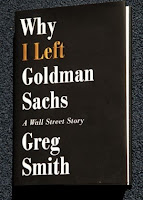
Why He Left Goldman

Image
It was the culture, he contends Recall about a year ago. It was the op-ed piece heard all around the business world, when Goldman Sachs vice president Greg Smith dared to announce his resignation on the pages of the New York Times . After an 11-year stint in its institutional sales unit, Smith announced he had had enough and it was time to depart. He decided to share publicly why his disappointments in the business culture led to his decision to leave a fairly lucrative position. (See  CFN: Goldman Sachs and the Letter, Mar-2012 ) At the time of his departure, Smith was head of U.S. Equity Derivatives in Goldman's London office. (In London, he was an "executive director," which at Goldman was equivalent to a U.S. "vice president.") He had progressed swiftly through the ranks and was highly regarded for his expertise in markets, clients and derivatives in his special perch. By most accounts, he was not a difficult employee and colleague. He had made meaningful ...


Why is Dell Going Private?

Image
Many know the story already. The story about how Michael Dell formed his own company in his college dorm room to sell personal computers. The story's plot soars toward an apex. Dell eventually took his company public, seized substantial market share, and eventually became a billionaire. His stake in the company today exceeds $3 billion (while he has maintained substantial wealth outside the company).  But the story is far from over. In recent years, the company has struggled to maintain market share and has suffered ups and downs in earnings and share prices.  It has reached a pivotal point, where it must decide what it wants to be, who its customer base should be, and what products, beyond conventional desktops, should it sell.  In recent days, founder Michael Dell decided it's time to buy back the company from the public and take it private with investments from himself and the private-equity firm Silver Lake. While reviewing alternatives (remaining a public firm or see...

No Win No Fee compensation claims procedure

Image
So you’ve been considering making a compensation claim, but with so many options on the market – and so many solicitors available, you aren’t exactly sure where to start. Many people love the sound of “No Win, No Fee” – and let’s face it, when presented with the idea of getting a compensation claim or not having to pay a penny, it’s not hard to see why for many people it’s an attractive offer. I think one of the most concerning parts of any offer such as this is that many of us are incredibly sceptical about things that are seemingly too good to be true, and if you find that you are in this boat, then chances are you will want to know more before you enter into an agreement of this type.  So what is a No Win, No Fee agreement and how does it work? To find out more about how these kind of agreements operate and to look at whether or not they might be right for you, scroll down! What is No Win, No Fee? So a No Win, No Fee agreement or Conditional Fee agreement as they are also known ...

Getting The Full Potential From Your Employees

Image
If you want to keep your employees happy and productive, you have to reward them. Many managers make the mistake of believing that the only way to motivate employees is with financial incentives. While your employees work for money, it is not what ultimately drives them. Positive reinforcement has been shown to have a huge impact on employee morale and performance. If you want to enjoy a productive workforce, you must reward and recognize them for their efforts.  Set Clear Goals Setting goals that are clear and attainable is crucial to your successful rewards plan. Your staff will have to know what goals they are trying to reach. These goals have to be attainable by your staff for maximum effectiveness. Create milestones and reward your staff for working towards the ultimate goal. If your goal is to sell 1,000 widgets a month, reward them for selling 250, then 500 and so on. Offer Group Rewards Many managers reward individuals for their merits, thinking that this will motivate othe...

Where Do You Want to Work in 2013?

Image
Lists can be amusing. Sometimes they might be taken seriously.  Magazine and media companies like to produce them--even if they are flawed or biased, because they sell thousands of copies of issues or generate thousands of Internet clicks. They spawn discussion and banter and get people talking. Some lists should be shrugged off and dismissed. Some are worth examining, because they might offer helpful information about the topic being ranked. Employees like good pay, good benefits and, yes, fitness centers Fortune Magazine compiles many lists from year to year. One recent list in its latest issue is its "Best 100 Companies to Work For." To believe in the list and to ensure it's credible and useful, you must believe in its criteria. You must be assured that Fortune has amassed significant data and measured the information properly. Ask employees why their company is a favorite place to work, and you may get dozens of reasons, including especially compensation, benefits, v...

General Election - Crisis or Opportunity?

Yesterday KLCI plunged 40 points (2.5%) to 1635, while the KLCI futures plunged almost 60 points to 1624! Technically speaking, KLCI has violated 50 day and 100 day moving averages, and looks like the next supporting level 1620 (200 day moving average) is shaky.  All these happened because the latest speculation on the election date is March 30th 2013 which has caused investors highly uneasy as they are worried about the outcome of the election. In my personal opinion, (no offence to any party), that there are 2 possible scenario: either the BN will win by marginally or lose by marginally, assuming the opposition party increases their parliamentary seats from 20% to 40%, ie, from the current 82 seats increases 20% to 98 seats based on the assumption that the MCA (Malaysia Chinese Association) will lose majority of its 15 Parliamentary seats plus several seats from other BN parties. Or for the opposition party to win marginally, they need to secure 112 seats out of the 222 parliamen...

Making Demands on Diversity

Image
Rogers: "We are just not fighting hard enough." Last fall, John Rogers of Ariel Investments found a convenient forum to discuss the state of diversity in finance. At a SIFMA diversity conference last October, he scolded executives and the rest of the industry about the woeful numbers from under-represented groups in senior roles. "The state of diversity in the industry," he reportedly said, "is appalling."  He added, "Ninety percent of leaders talk a big game, but...we have gone backwards. We are just not fighting hard enough." Rogers is Ariel Investments ' founder and CEO. He, also, happens to be a pioneering African-American in the industry, one who has been a prominent investor and leader in mutual funds for 30 years. Hence, Rogers is no new kid on the block, not an industry novice who just appeared on the scene to make this striking, candid observation.  He has seen dozens of market trends and phenomena, endured more than a few volatile m...