Posts

Showing posts with the label Profiles

How Will Steven Cohen's Saga End?

Image
Should investors take the money and run? If you were fortunate to invest in Steven Cohen's hedge fund, what would you do? Keep the faith, and keep your funds in SAC Capital Advisors?  Or take the money and run, while government investigators pore through trading records for evidence of insider-trading? How will the SAC Saga end? Tucked away along I-95 on the winding hedge-fund corridor in Connecticut is the home of the closely cloaked $14 billion hedge fund run by Cohen.  In the world of quantitative trading and hedge-fund investing, Cohen's SAC Capital is well known, envied by many, desperately copied by others, and revered by most in the investment community. These days, the fund is known outside the hedge-fund world because of  the investigative cloud that lingers above it. Since its 1992 founding, an obsessed Cohen permitted few to learn about his fund's operations, performance, and trading strategy.  For most of the fund's existence, Cohen avoided public appeara...
What Will Dimon Do?

Image
WWJD. Not what would Jamie Dimon do? But what will Jamie do? Waiting Anxiously for the Shareholder Vote In a matter of days, JPMorgan Chase shareholders will find out the results of a crucial vote to determine whether Chairman and CEO Jamie Dimon should relinquish  his role as Chairman of the bank holding company. In a similar vote last year, 40% of shares outstanding voted for him to give up the role as Chairman.  A year later, Dimon and JPMorgan have had to digest continual impact from the billions in trading losses in the infamous "London Whale" credit-derivatives debacle. They have endured stiff criticism from regulators for how JPMorgan managed those losses and for how regulators perceived the bank was behaving in response to inquiries. Dimon has already been penalized for "Whale" mistakes when his 2012 bonus was reduced, even as JPMorgan continued to generate extraordinary earnings last year and in 2013's first quarter. His inner circle of senior managers ...

Why He Left Goldman

Image
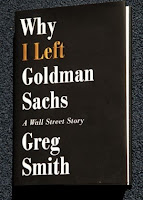
It was the culture, he contends Recall about a year ago. It was the op-ed piece heard all around the business world, when Goldman Sachs vice president Greg Smith dared to announce his resignation on the pages of the New York Times . After an 11-year stint in its institutional sales unit, Smith announced he had had enough and it was time to depart. He decided to share publicly why his disappointments in the business culture led to his decision to leave a fairly lucrative position. (See  CFN: Goldman Sachs and the Letter, Mar-2012 ) At the time of his departure, Smith was head of U.S. Equity Derivatives in Goldman's London office. (In London, he was an "executive director," which at Goldman was equivalent to a U.S. "vice president.") He had progressed swiftly through the ranks and was highly regarded for his expertise in markets, clients and derivatives in his special perch. By most accounts, he was not a difficult employee and colleague. He had made meaningful ...

Making Demands on Diversity

Image
Rogers: "We are just not fighting hard enough." Last fall, John Rogers of Ariel Investments found a convenient forum to discuss the state of diversity in finance. At a SIFMA diversity conference last October, he scolded executives and the rest of the industry about the woeful numbers from under-represented groups in senior roles. "The state of diversity in the industry," he reportedly said, "is appalling."  He added, "Ninety percent of leaders talk a big game, but...we have gone backwards. We are just not fighting hard enough." Rogers is Ariel Investments ' founder and CEO. He, also, happens to be a pioneering African-American in the industry, one who has been a prominent investor and leader in mutual funds for 30 years. Hence, Rogers is no new kid on the block, not an industry novice who just appeared on the scene to make this striking, candid observation.  He has seen dozens of market trends and phenomena, endured more than a few volatile m...

Why Was Citi's CEO Asked to Resign?

Citigroup caught everybody off guard this week, when its board announced it had asked for the sudden resignation of CEO Vikram Pandit. Or did it catch anybody off guard? Was this a gesture  investors pushed for? Was it the right move for the big global financial institution that seemed to have leaped a hurdle to move beyond the darkest days of the financial crisis--back when there were moments when many thought its survival was in jeopardy? Over the past few years, Pandit and team took appropriate, bold steps to make the behemoth profitable again. They sold assets en masse . They shuffled bad, non-performing, defaulted, bankrupt, and/or foreclosed assets into a special holding company and, little by little, sold off these positions, properties, securities and full operations.  By doing so, it rid itself of spoiled segments and began to polish ongoing core operations.  They downsized in every way possible--in just about every unit, operation, division, and geography. They ...

JPMorgan's Dimon: A Regulatory Rant

Finance professionals strive to keep up to date with markets, trends and rules. They have a check-list of reading material, journals and documents they refer to from time to time. They scan the Wall Street Journal , Financial Times or BusinessWeek whenever they can. They peek at investment magazines and websites when they think they must.  They peruse SEC documents, accounting rulings, equity research, and analyses from ratings agencies. Each spring, they find time to read Warren Buffet's annual letter to shareholders--often a primer in investment basics, occasionally a skillful interpretation of finance trends or opportunities. Or if finance professionals are wedded to trends and fashions in financial services, they tune to JPMorgan Chase's Jamie Dimon and his state-of-the-industry message in the annual shareholders letter.  Since he took the helm as CEO in the mid-2000s, Dimon has used this forum to present more than an analysis of revenues and profits.  Dimon takes th...

Role Models and a New Network

Image
NYU-Stern graduate Daria Burke Who are the women of color, the women from under-represented groups who occupy "C-suite" positions at companies involved in global business? A roster of such names usually includes Ursula Burns at Xerox , Andreae Jung (until earlier this month) at Avon , and Indra Nooyi at PepsiCo , CEOs of companies with billions in revenues and even greater numbers in market value. Burns, Jung, Nooyi and others preside over companies, business sectors, geographic units, corporate brands, major subsidiaries and functions in finance and treasury. They would also be women from who hustled, regrouped, paused to raise families, scratched, climbed and willed their way into top spots, board rooms and significant leadership positions.  Their  few numbers, while growing, suggest there is still a ways to go. Those in CEO roles, such as Burns, Nooyi and Jung, are known and are seen commanding the podium at shareholder meetings or outlining strategic plans in a broadca...

Something Different: A Special NFL Documentary

Image
From Emory MBA to Film Production Now and then MBA graduates depart from business school with aspirations to succeed in a conventional career: Consulting, banking, investing, marketing, or start-ups.  Somewhere along the way, they  re-discover themselves or  re-kindle other passions and head into other directions.  They find new interests and opportunities. And off they go.  Sometimes they transition into another conventional pursuit. Or sometimes pursue something off the beaten paths. Theresa Moore, a Harvard athlete and graduate, earned an MBA from Emory (now a Consortium school) and started out conventionally in marketing at Coca-Cola.  However, along the way, she switched courses, while  taking advantage of her business education and experiences.  Today she runs her own film-production company and directs and produces her own documentary projects. Her most recent project aired on CBS-TV in December and the NFL Network in February. She directe...

Parsons: On to the Next Phase

Image
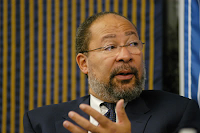
What's next for Parsons? A fter an illustrious business career that spanned decades, Richard Parsons is calling it quits this month.  He announced he wouldn't pursue re-election as chairman of the board at Citi. (Citi , as many know, has been an important, decades-long supporter of the Consortium and a host at Orientation Programs and Consortium events in New York.) Has an era ended?  Parsons has been a pioneer in many ways, and he wraps up a career filled with quite a few "African-American" firsts."  He was CEO in the 1980s at Dime Savings Bank, at that time a well-known New York regional bank. He later became CEO at AOL Time Warner in the 2000s, landing right in the middle of turmoil from the cantankerous combination of AOL and Time Warner.    Few African-American lead or have led major financial institutions, so Parsons' exit from the Wall Street scene is noteworthy.  In 2012, Kenneth Chennault continues to preside over American Express . Stanley O’Ne...

Firm Culture: Could You Work Here?

Image
 Dalio of Bridgewater Associates  Bridgewater Associates is a successful, $90 billion hedge fund, located along the Connecticut corridor where other successful, gargantuan hedge funds have a home base. Ray Dalio , a Harvard Business School graduate, is its founder and leader. The fund's investors include pension funds and university endowments. Over 1,000 people are employed in a variety of roles.  It recruits those who are tough-skinned, highly motivated and interested in a long-term career at the fund. MBAs in finance would no doubt be attracted to an opportunity there. Would you want to work there? Would it be a place where you can find a niche, thrive and be successful? Would you be able to endure hardships and demands to perform well? Would you be able to stomach equity volatility, risks of losses, and virulent market turmoil? And would you be able to perform under pulsating pressure and high expectations? Bridgewater is also known as a fund ...