Posts

Showing posts with the label Investment Banking

Goldman Sachs and Work-Life Balance

Goldman Sachs announced this week that it had instituted ways to improve the work experience of analysts (in its BA program) and reduce the number of hours they work each week. It's the lore of investment banking to hear stories of analysts and MBA associates, too, who work long hours that stretch through the weekend and through holidays and vacation time. Goldman acknowledges that it is missing out on some top talent, when recruits have selected other finance jobs or industries because of work-life-balance issues. Talented BA's and MBA's will express an interest in corporate finance, will have the aptitude and drive to work on deals and with important clients, but, as Goldman sees it, they back out and accept offers elsewhere. And they may whisper to Goldman and other major banks that it wasn't about the compensation.  Thus, they choose pathways that take them to the shorter hours and better lifestyles offered by hedge funds, smaller boutique firms, and the f...

Apple, With All That Cash: Revisited

Image
Billions and billions in cash, still In corporate-finance circles,  Apple presented a delightful dilemma in much of 2012.  What should it do with its billions of cash, sitting on the balance sheet, earning paltry returns in safe markets, causing restlessness among shareholders who felt entitled to special dividends to get access to it? Should it use cash to repurchase some stock, a few shareholders pressed? Shareholder activists clamored for cash pay-outs and even devised ingenious financial maneuverings and new equity instruments to get to it.  The current generation of Apple managers, with Tim Cook at the helm as CEO, grew up with Steve Jobs' abhorrence of debt markets and his clinging to a security blanket of hoarded cash if only to endure tough times. Apple has often countered--in carefully worded ways--that much of the cash it maintains appears in foreign subsidiaries, cash that couldn't be efficiently repatriated back to the U.S. into the hands of shareholders with...

The Verizon Deal: Big Numbers, Big Debt

When the deal was announced, some surely gasped.  The fact that Verizon Communications decided to purchase all of Vodafone's stake in Verizon Wireless was not a surprise.  Vodafone had decided to sell its stake and units in mobile phones.  What likely caused market observers and headline writers to turn their heads in wonder was the size of the deal, the big numbers. They were huge. Deals and big numbers excite investment bankers and can spur them to pant and salivate. In the Verizon case, they certainly will, once Verizon gets around to handing out advisory and underwriting checks for fees. Deals and big numbers tend also to cause hiccups and coughs among some investors, research analysts and bank risk managers. This deal is big, one of the largest ever. Perhaps it sends too many hopeful signals that an era of super-size deal-making has returned.  Verizon Communications announced it will pay a whopping $130 billion for Vodafone's stake. To raise $130 billion to pay ...

Now It's Twitter's Turn

Now it's Twitter's turn. It hesitated for the past year or so. This week (Oct., 2013) it bravely stepped into IPO waters, taking the first big step by sharing publicly its SEC filing and letting the financial world see its bottom line. Twitter's hesitation, like all companies contemplating issuing stock to the public for the first time, results from trying to determine the optimal moment to sell stock in equity markets. That's often tied to market interest in the stock issue, supply and demand for the stock, and general equity-market trends. Its hesitation may have also resulted from other factors: (a) its being shy about letting the world pore through its true financial performance and (b) its desires to avoid the IPO debacle Facebook experienced last year at Nasdaq with Morgan Stanley as the lead underwriter. Twitter through the years has had to wrestle, too, with management and organizational issues. Some of those problems have been resolved, and the company has move...

Merger Mania: Boom Times Ahead?

Image
Is this an era of good feeling in mergers and acquisitions? Time for a break-up or spin-off? Every other day in the financial media, a deal announcement soars through the headlines.  Dell's founder, Michael Dell, wants to buy back his company, but others bid for the same and "put the company in play" (sort of). US Airways and American Airlines agree to a blockbuster combination that lifts one of the companies out of bankruptcy. Warren Buffett and his Berkshire team decide to purchase Heinz for $23 billion, reinforcing the long-time notion that Buffett has the uncanny knack for extracting value from even the most mature food-products industries.  Sprint Nextel has its eyes on Clearwire.  In the past week, an aggressive activist investor wants to shake up Sony Corp. and spin out its entertainment division, the unit that includes movies and music labels. Dan Loeb, using his Third Point investment-fund vehicle, prepares to take on the entrenched customs of the Japan financial...

What Will Dimon Do?

Image
WWJD. Not what would Jamie Dimon do? But what will Jamie do? Waiting Anxiously for the Shareholder Vote In a matter of days, JPMorgan Chase shareholders will find out the results of a crucial vote to determine whether Chairman and CEO Jamie Dimon should relinquish  his role as Chairman of the bank holding company. In a similar vote last year, 40% of shares outstanding voted for him to give up the role as Chairman.  A year later, Dimon and JPMorgan have had to digest continual impact from the billions in trading losses in the infamous "London Whale" credit-derivatives debacle. They have endured stiff criticism from regulators for how JPMorgan managed those losses and for how regulators perceived the bank was behaving in response to inquiries. Dimon has already been penalized for "Whale" mistakes when his 2012 bonus was reduced, even as JPMorgan continued to generate extraordinary earnings last year and in 2013's first quarter. His inner circle of senior managers ...

What Happened at JCPenney?

Image
Waiting for the invitable b-school case Eventually this will become an intriguing business-school case, particularly for those concentrating in marketing and general management.  Activist investors push hard to re-engineer, restructure and revitalize JCPenney, the old retailing outfit--languishing in modern times, struggling to expand, and suffering with losses and a tanking stock price in the post-recession recovery. The old CEO resigns, and the company figures it has found the solution in a dynamic new CEO, who would swoop in and radically change JCP by casting upon it magical dust from Steve Jobs and Apple.  JCP, amidst fanfare, hires Ronald Johnson after he helped spawn and lead Apple's broadly successful and wildly popular store expansion.  Apple, Jobs and Johnson had transformed the branch-store and electronic-purchasing experience into in-store theater. JCP succumbs to the nudges from shareholder activist and prominent investor William Ackman. They reason that John...

Why He Left Goldman

Image
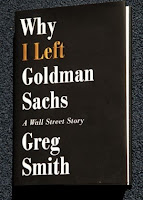
It was the culture, he contends Recall about a year ago. It was the op-ed piece heard all around the business world, when Goldman Sachs vice president Greg Smith dared to announce his resignation on the pages of the New York Times . After an 11-year stint in its institutional sales unit, Smith announced he had had enough and it was time to depart. He decided to share publicly why his disappointments in the business culture led to his decision to leave a fairly lucrative position. (See  CFN: Goldman Sachs and the Letter, Mar-2012 ) At the time of his departure, Smith was head of U.S. Equity Derivatives in Goldman's London office. (In London, he was an "executive director," which at Goldman was equivalent to a U.S. "vice president.") He had progressed swiftly through the ranks and was highly regarded for his expertise in markets, clients and derivatives in his special perch. By most accounts, he was not a difficult employee and colleague. He had made meaningful ...

Why is Dell Going Private?

Image
Many know the story already. The story about how Michael Dell formed his own company in his college dorm room to sell personal computers. The story's plot soars toward an apex. Dell eventually took his company public, seized substantial market share, and eventually became a billionaire. His stake in the company today exceeds $3 billion (while he has maintained substantial wealth outside the company).  But the story is far from over. In recent years, the company has struggled to maintain market share and has suffered ups and downs in earnings and share prices.  It has reached a pivotal point, where it must decide what it wants to be, who its customer base should be, and what products, beyond conventional desktops, should it sell.  In recent days, founder Michael Dell decided it's time to buy back the company from the public and take it private with investments from himself and the private-equity firm Silver Lake. While reviewing alternatives (remaining a public firm or see...

Today's "Bulge Brackets"

Image
Who comprises the Bulge Brackets of 2013? "Bulge brackets" in investment banking was once an acclaimed list of investment banks that dominated most of the activity in the industry--from staid, conventional bond underwriting to mergers-and-acquisition advice to flamboyant IPOs.  "Bulge bracket" signaled dominance and prestige. It implied a bank was a major player. Statistics and market share determined who made the list or not, and it was often a moniker awarded to banks that finished in the top five in most finance categories. Say "bulge bracket" and those who trade and do deals and those who follow the industry think immediately of Goldman Sachs and Morgan Stanley.   Just a few years ago, Lehman Brothers and Merrill Lynch were "bulge bracket" mainstays.  Go back decades, and banks such as Salomon Brothers, Drexel Burnham, First Boston , and DLJ might have squirmed their way into a top-5 listing. Often they did, back then. Today, they don'...

Bring on 2013: Cliffs, Reforms, Recovery

Image
What lies ahead in finance? After a long haul and after markets watched and studied the results, we've jumped the hurdle of the presidential election . We now head toward a year-end where sound bites and gurgles of noise from Washington scream "fiscal cliffs" and a possible end-of-world scenario if legislators don't reach an agreement and unveil a fiscal plan before January 1. Often in an election year, capital markets and finance managers go through pauses, starts and stops. They gauge the political winds that will affect economic recovery, interest rates or the tendencies for companies to invest in growth, merge with others, borrow long term or issue new stock. The election is done, and it's time to bring on 2013, of course, after legislators cease jousting with each other. What lies ahead for professionals in finance ? What is the outlook for those who manage portfolios, trade derivatives, underwrite securities,  borrow funds, invest in big projects, advise cli...

Jefferies: Comfortable in its Niche

Image
In finance circles, Jefferies , the mid-sized, New York-based investment bank, is a "tweener"--too big and mature to be a young upstart, but not  large or imposing enough to earn the label "bulge bracket" or "too big too fail." Like a Knight Capital or MF Global, if Jefferies were in danger of sliding into oblivion, government regulators and market counterparties would let it go. Amidst all the post-election squabble about "fiscal cliffs" and recent stomach-churning market volatility, Jefferies quietly slipped into the business news this month. It agreed to be acquired by its minority owner, the conglomerate holding company Leucadia .  The transaction won't shake the broker/dealer world. It may hardly move anybody in any way. But it brings to mind the consistent, stable performance of a niche investment bank, one that has always been too small to be a threat of any kind to behemoths Morgan Stanley, Goldman Sachs and JPMorgan. Yet it is one ...

UBS Throws in the IB Flag

UBS , the Zurich-based global financial institution, announced last week that it plans to dismiss 10,000 employees as it continues, like most big banks, to review, revamp and re-scale its business units around the world.  That's not an unusual news item. In financial services, that's a news blurb we see almost every other day. UBS provided more details.  Most of the dismissals will come in its investment-banking group.  More specifically, its fixed-income businesses will suffer the most.  The dismissals, the down-scaling and shrinkage are unfortunate. The announcements are, nonetheless, not shocking, since they are a common event in the business press. This might, however, be the first wave of dismissals in finance, where the bank stepped up to admit  blame solely on its inability to justify business lines because of hefty capital requirements from the new wave of regulation. UBS says new regulation (in Switzerland and from the reforms of Basel II, II.5, and III...