Posts

Now You Can Subscribe To Pauline Yong’s Trading Strategies Through ChartNexus XPertTrader Charting Software.

Image
In collaboration with ChartNexus, Pauline Yong has incorporated her unique trading strategies into ChartNexus XPertTrader charting software so that subscribers can apply the strategies to buy and sell blue chip stocks and other general stocks in Bursa Malaysia as well as other foreign stock markets. Benefits of Subscribing the ChartNexus XPertTrader Charting Software After subscribing ChartNexus, you can use Pauline Yong’s proven trading strategies – Sigma Wealth (SW) Blue Chip Buy Signal, SW Blue Chip Sell Signal to scan your watchlist, preferably the blue chip stocks list regularly for any buying or selling opportunities. The SW Blue Chip Buy Signal is designed to scan for buying opportunities for blue chip stocks that are intended for medium term to long term hold, hence speculation is not encouraged here when applying this strategy. On the other hand, the SW Blue Chip Sell Signal is to scan for weaknesses in the market so that investors will not hold on to the losers in a severe do...
Prospect Theory

Image
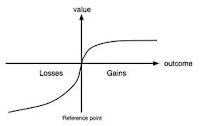
According to Tversky and Kahneman, the prospect theory explores how an individual behaves when face with a risky situation. This theory suggests that when we are presented with choices, we consider the effects of each option relative to our present circumstances. Will we gain or lose relative to our current status quo? Definitely, we prefer gains because it is always better to receive money than to lose it. Hence, Kahneman and Tversky’s crucial contribution was the recognition that losses and gains are not weighed equally - for the same amount of gains and losses, losses hurt more than gains. Below is the diagram showing the difference between the human perception on gains and losses. As shown, gains and losses relative to the current status quo are measured on the horizontal axis, and the perceived value of these gains and losses is presented on the vertical axis. As indicated, losses produce a greater change in value than equal size gains: losses hurt more than gains. Similarly, many...

Overconfidence

Under the paradigm of traditional financial economics, decision makers are considered to be rational and utility maximizing. The assumption of rational expectations is simply an assumption - an assumption that could turn out not to be true. Behavioural Finance has the potential to be a valuable supplement to the traditional financial theories in making investment decisions. For the past few weeks I have introduced several behavioural finance concepts including: Availability Bias, Representative Bias, Anchoring Bias, Mental Accounting and Framing Effect. Next, I’m going to tallk about “Overconfidence”. Overconfidence is a very common behaviour whereby investors tend to think that they know more than they actually do. They often overestimate their predictive skills and believe they can time the market. One classic example is listening to rumours. Investors who make investment decisions based on listening to hearsay rumours tend to be overconfident about the situation. Personally, I know ...

Mental Accounting

Suppose you are going to a movie and as you enter the cinema, you discover that you have lost your movie ticket you’ve just paid RM10 for. Would you spend another RM10 to get a new one? If you are like most people, you would probably think twice because you will feel that you will end up paying RM20 for a movie actually worth RM10! Now let’s construct the scenario differently. You are going to see a movie. On your way to the movie theatre you drop a RM10 note on the bus. You are disappointed, of course, but would this affect your decision to buy the movie ticket? You will probably say to yourself: “Damn it! That’s my luck!” Arriving at the cinema, you will forget about the incident and stand in line to get a movie ticket. In fact, the above research was conducted by some psychologists who discovered that only 46 percent of those who lost a ticket were willing to buy a replacement ticket, whereas 88 percent of those who lost an equivalent amount of cash were willing to buy a ticke...

Anchoring Bias

In Professor Kahneman and Tversky’s 1974 paper, they describe anchoring bias as this: “In many situations, people make estimates by starting from an initial value that is adjusted to yield the final answer. The initial value, or starting point, may be suggested by the formulation of the problem, or it may be the result of a partial computation. In either case, adjustments are typically insufficient. That is, different starting points yield different estimates, which are biased toward the initial values. We call this phenomenon anchoring.” An experiment was done to prove this theory. There were two groups of students given the following arithmetical expressions respectively and were to give an estimate within 5 seconds. Group A: 1 x 2 x 3 x 4 x 5 x 6 x 7 x 8 Group B: 8 x 7 x 6 x 5 x 4 x 3 x 2 x 1 Group A made a median estimate of 512, while group B made a median estimate of 2,250. The motivating hypothesis was that students would try to multiply the first few factors o...

Representative Bias

Happy New Year 2011! Hope this year is another fruitful year for our local stock market! Today I’ll continue with last week’s topic on behavioural finance. Today I’m going to talk about “Representative Bias”. Representative bias refers to the human bias in us that we often stereotype certain things with similar characteristics with similar outcome. For example, whenever we see a beggar, he or she must be poor, that’s our first thought. However, there are cases where some of them live in big houses! Another example, bad drivers – if you see a bad driver, it must be a lady! So all these are stereotyping! When this theory applies to our stock market it becomes like: politically linked stocks but no profits, buy! Because it sure goes up! Datuk so and so’s company – buy! He usually “goreng” his own stocks! Hence we tend to stereotype the stocks with similar nature such as traits like politically linked or owned by some famous VIP, their stocks usually can soar very high, and we neglected ot...

Availability Bias

Starting from this week I am going to introduce to my readers the different types of mental bias that will hider successful trading in us. Today’s topic is “Availability Bias”, a behavioural finance theory that is based on Kahneman and Tversky’s famous literature – Judgement Under Uncertainty: Heuristics and Biases in 1974. According to the availability bias theory, people pay attention to anything in the media that supports their fear and perception and ignore the other side of the story. In short, availability bias makes people less objective when making decisions. For instance, many people have misconception about investing in the stock market. When asked why they rather put their money in the bank than in the stock market, they said: “Why? Because I don’t want to lose all my savings”. People typically give too much weight to recent experience and extrapolate recent trends that are at odds with long-run averages and statistical odds. They tend to become more optimistic when the mark...